

Everyone’s a musician at The Pines School. There’s a band, orchestra, string ensemble, chamber ensembles and three Taiko drumming groups. Every student gets access to a weekly instrumental lesson and daily practice time. Teachers learn alongside students, and the entire community, including parents and grandparents, come together to enjoy performances through the year.

Two Pines School students play cellos. Credit: Sam Oster
Is this a specialist music school?
No. In fact, it’s a disadvantaged school in a low socio-economic area of North Adelaide which caters to a community enriched by many recent immigrants. Every year The Pines welcomes students who are new arrivals to Australia — many of them refugees recovering from disrupted lives and trauma — into its Intensive English Language Program. There are over 60 different cultures and nationalities represented in the student body.

Students play to the Pine School Principal Cherie Collings. Credit: Sam Oster
So why so much music? The Pines School Principal, Cherie Collings, does not hesitate:
‘I truly believe music helps children. I believe it contributes to their understanding and their brain development for literacy, numeracy and well-being. It helps them regulate and learn. Music's just a wonderful thing that makes them feel happy.’
Collings, who was winner of the Excellence in Leadership at the 2023 Public Education Awards in South Australia, has spent her 13 years at The Pines School well, building resources and capacity, expanding the school body from 300 to 700, and establishing the music program. In 2020 she successfully applied for the School to join Musica Viva Australia’s Music Education Residency Program. From there the School’s arts program grew and grew, with more instrumental and performance opportunities and, last year, the introduction of a string program for the youngest of students. The activities have been enthusiastically embraced by the entire community.
‘A few years ago our upper primary students composed and wrote a school song. [MVA Music Education Residency Teaching Artist] Adam Page came and helped our orchestra put together the music and we play it at assemblies. It showcases the children but it also showcases the instruments they are learning, and lots of their activities. I'm always so excited about all the work the children put into it.’
‘I truly believe music helps children - It helps them regulate and learn. Music's just a wonderful thing that makes them feel happy.’
Music can be particularly useful with students who have behavioural or learning difficulties, Collings says.
‘I often find with kids that find it hard to regulate their behaviour that learning an instrument provides an area where they can achieve and develop self-confidence and work in a team.’
The focus on music has also uncovered talent in unexpected places.
‘One of the girls who has always found learning a bit tricky picked up the trumpet and it turns out she's brilliant. She’s really gifted. It's given her so much confidence. She enjoys school more. She's been out the front at assembly playing.’
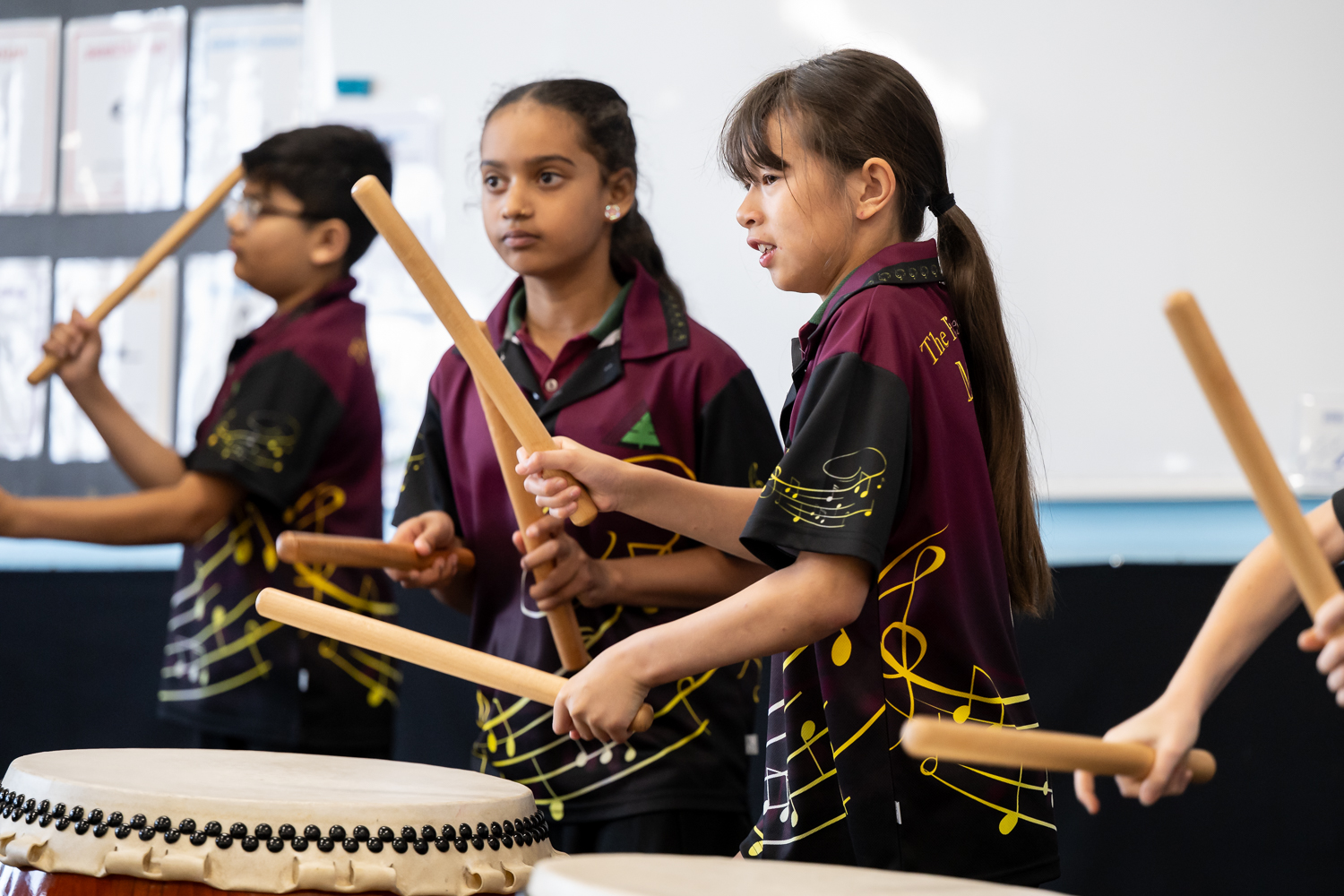
TAIKO DRUMMING GROUP credit: Sam Oster
At the end of 2025 Collings took a break from a long career in education. She’s sad to say goodbye to The Pines School, but proud to be leaving the School with so many opportunities in place, and such a supportive community.
‘Things won't necessarily stay the same. They may change and that's fine. But I’ve been thinking about all the children in the last five years who have had the opportunity to learn an instrument… It’s hundreds! How wonderful is that?’
The Pines School's music program has been developed as part of the Music Education Residency Program, Musica Viva Australia's immersive, three-year program aimed at integrating quality music education into schools. Find out more about the Residencies here.
The delivery of Musica Viva Australia’s Music Education Residency Program in South Australia has been made possible thanks to generous funding from our supporter community. We extend special thanks to those who have contributed to this multi-year initiative to date:
Aldridge Family Endowment
Carthew Foundation
Day Family Foundation
Foskett Foundation
FWH Foundation
John & Jennifer Henshall
Margo Hill-Smith
Lang Family Foundation
McDougall Telfer Foundation
Seeley International Foundation